Commercial and builder hydroseeding
Rutherford, Williamson and Wilson counties are adding subdivisions faster than almost anywhere in Tennessee. Every one of them needs disturbed ground stabilized on a deadline. We connect builders and site contractors with hydroseeding crews who can handle lots, common areas and acreage.
Updated November 14, 2026
Who this is for
- Home builders who need finished lots seeded before closing or final inspection
- Developers with subdivision common areas, entrances, amenity lots and detention ponds
- Site and grading contractors who need temporary and permanent stabilization on cut and fill areas
- Commercial property owners with new retail, office, church or school sites
- Utility, road and pipeline contractors restoring right-of-way after trenching
- Farms and land owners seeding pasture, pond dams or cleared ground
Stabilization rules in Tennessee
Construction sites that disturb one acre or more, or that are part of a larger common plan of development such as a subdivision, generally need coverage under the Tennessee Department of Environment and Conservation (TDEC) General Permit for Discharges of Stormwater Associated with Construction Activities. That permit requires a Stormwater Pollution Prevention Plan (SWPPP) and sets deadlines to stabilize disturbed soil once work in an area stops, along with inspections and final stabilization before the permit can be closed out. Murfreesboro, Franklin and other cities with their own stormwater programs add local requirements on top.
The exact deadlines and the definition of final stabilization are in the current permit and your SWPPP, so check those documents. In practice, many sites need temporary cover seeded within days or a couple of weeks of grading stopping in an area, with shorter timelines on steep slopes, and permanent vegetation established across the site before closeout.
We are not your SWPPP preparer or inspector. Your contractor will seed to your plan’s specifications; your design professional and TDEC or city staff are the authority on what the permit requires.
Why hydroseeding fits site work
- Speed: a single truck can cover several acres in a day, much faster than drilling or straw on irregular ground.
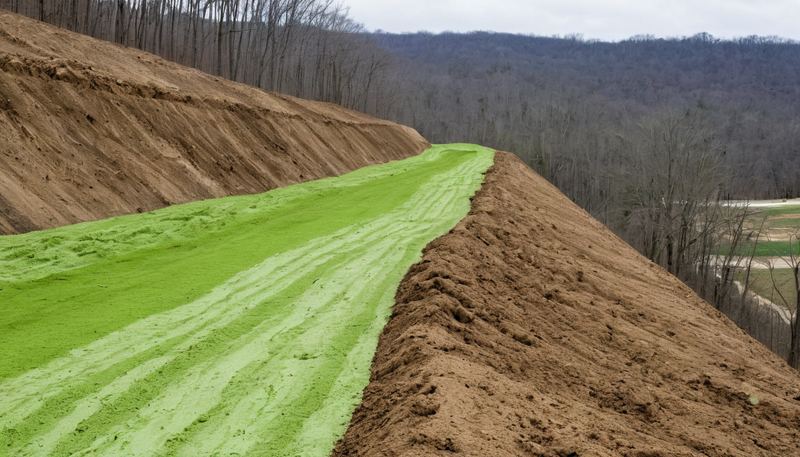
- Slopes and edges: the hose reaches banks, pond slopes and areas equipment cannot drive on.
- Even coverage: the colored slurry shows exactly where it has gone, which helps on inspections.
- Built-in mulch: fiber mulch and tackifier provide the erosion protection that straw otherwise would, without blowing into the street or neighbors' yards.
- Specification-friendly: seed mix, fertilizer, lime and mulch rates can be matched to your plan or TDOT-style specifications.
Temporary and permanent seeding
Most sites need both. Temporary seeding holds ground that will be disturbed again later or that cannot get permanent grass in the current season. Common choices are annual ryegrass or cereal rye in fall and winter and millet in summer, with mulch. Permanent seeding goes on final-graded areas: typically tall fescue in fall, Bermuda in warm months, or a native mix on areas that will not be mowed.
A contractor who does a lot of builder work can set up a schedule: temporary seeding on phases as they are graded, permanent seeding on lots as they finish, and touch-ups after inspections.
Lot-by-lot work for builders
For production builders, the steady work is seeding finished lots as homes complete. Contractors can quote a per-lot or per-square-foot price, show up on a few days' notice when the landscaper finishes, and handle common areas at the same time. Ask about:
- Price per lot by size band, and whether fine grading is included
- How much notice they need and how quickly they can turn a lot around
- Who handles watering before the buyer moves in
- Warranty or re-spray policy if a lot fails to come in
- Invoicing by community or phase
Acreage, pasture and large sites
Above a few acres, pricing moves to per acre. Water supply becomes a planning item: crews refill tanks from a hydrant meter, a pond or a water truck, and distance to water affects how fast they work. Access for the truck, slope steepness and the mulch specification have the biggest effect on the price.
What to send for a fast quote
- Site address or community name and phase
- Approximate acreage or square footage to seed, or a site plan with the areas marked
- Seeding and mulch specifications from your SWPPP or plans, if any
- Slopes steeper than 3:1 and any channels or pond banks
- Water source on site (hydrant meter, pond, none)
- Whether it is temporary or permanent seeding, and your deadline
- For lot work, the number of lots per month and typical lot size
With that information, most contractors can price large jobs from the plans and only need a site visit to confirm access.
Records for inspections and closeout
SWPPP inspections and permit closeout go more smoothly with good records. Ask your hydroseeding contractor to provide, for each visit:
- The date and the areas seeded, ideally marked on a site map
- The seed mix and rate, mulch product and rate, and fertilizer and lime used
- Photos before and after application
Keep these with your SWPPP inspection reports. When it is time to show final stabilization, dated records and photos of the seeding, followed by photos of established cover, make the case clear.
Common reasons site seeding fails
- Seeding on compacted, smooth-bladed subsoil with no tracking or roughening
- Paper mulch or low mulch rates on slopes
- Permanent grass seeded in the wrong season with no nurse crop
- Construction traffic driving over seeded areas
- Concentrated runoff from roads or pads cutting across seeded slopes
Planning around these up front costs far less than re-seeding a phase before an inspection.
Questions from builders
Can you seed lots in winter?
Yes. Contractors can apply a temporary cover such as annual ryegrass or cereal rye with mulch, or a dormant seeding. Mulch alone provides soil cover while it is too cold for seed to sprout.
Do your contractors follow our SWPPP specifications?
Give the contractor your plan’s seeding and mulch details and they will price and apply to them. Ask them to note the mix, rates and dates on their invoice for your records.
Can you set up recurring work across several communities?
Yes. Tell us your communities and typical monthly lot count, and we will connect you with a crew that can take on steady builder work.
Builders and site contractors: send your community, lot count or acreage, and timing for a fast price.
Request a builder quote or call (615) 784-9092