Hydromulching
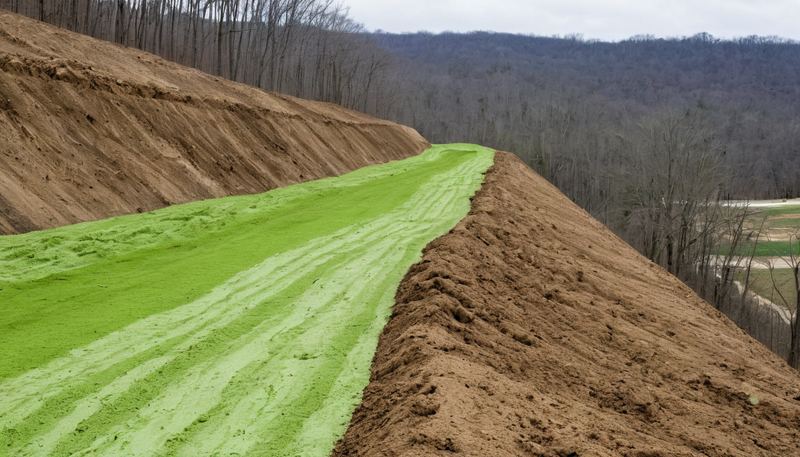
Hydromulch is the fiber layer in a hydroseed slurry, sprayed on its own or over seed that has already been spread. It covers bare soil fast, holds moisture and stops erosion until grass or other plants take over.
Updated November 14, 2026
Hydromulch and hydroseed: same thing?
People use the words interchangeably, and most of the time they mean the same job: seed, fertilizer and mulch sprayed together in one slurry. Strictly speaking:
- Hydroseeding is the one-step process, with seed in the tank.
- Hydromulching is spraying the mulch layer. That can be on its own (no seed), or as the second step after seed has been drilled or broadcast.
So if you have been searching for “hydroseeding hydromulching” or “hydroseed mulch”, you are in the right place either way.
When to use hydromulch on its own
- Temporary soil cover: a construction area that will be regraded later, where you just need to stop dust and erosion for now.
- Out-of-season stabilization: when it is too cold or too hot for seed, mulch protects the soil until the seeding window.
- Over drilled seed: on large areas, a contractor may drill seed for the best soil contact, then hydromulch on top for moisture and erosion protection.
- Around plantings: on slopes planted with shrubs, groundcovers or plugs, mulch holds the soil between plants.
- Two-step seeding on steep slopes: seed and some mulch go down first, then a heavier mulch or bonded fiber matrix layer goes over the top.
Types of hydromulch
Paper mulch
Made from recycled paper. Cheapest, breaks down quickly, and fine for flat lawns, but it does not hold well on slopes or through heavy rain.
Wood and paper blends
A middle option often used on residential lawns, with better water holding and strength than paper alone.
Wood fiber mulch
Longer, thermally refined wood fibers that interlock. Holds more water and stays put on moderate slopes. This is what most erosion-control work uses, usually with a tackifier mixed in.
Bonded fiber matrix and engineered mulches
Wood fiber combined with strong binders, sometimes with added synthetic fibers. Sets into a continuous, porous layer that resists rain impact and runoff on steep slopes. Applied heavier and costs more.
Application rates
Mulch rates are usually stated in pounds per acre. Lawns on flat ground use the lightest rates; erosion-control and steep-slope work use much heavier rates, often applied in more than one pass so each layer can bond. Manufacturers publish recommended rates for each product by slope. If you are comparing quotes, ask each contractor what mulch product and rate they are using, because a cheaper quote may simply mean less mulch.
What is in the tank besides mulch
- Tackifier: a binder, often plant-based (guar or psyllium) or a polymer, that glues the mulch and seed to the soil.
- Fertilizer: usually a starter fertilizer for new seedings, adjusted to a soil test when available.
- Lime: some Middle Tennessee soils are acidic enough to benefit; a soil test tells you.
- Green dye: a marker so the operator can see coverage. It fades in a few days.
- Optional extras: soil conditioners, biostimulants or water-holding additives. Worth it in some situations; ask what they add and why.
Hydromulch in winter
From roughly November through February, it is usually too cold in Middle Tennessee for permanent grass seed to sprout. Bare ground still erodes in winter rains, though, and construction sites still have stabilization deadlines. Hydromulch on its own, or with a cold-tolerant cover like cereal rye or annual ryegrass, covers the soil right away. Contractors avoid spraying onto frozen or waterlogged ground, because the mulch will not bond and can slide off as the surface thaws. A mild, dry stretch of days is the time to apply it. In spring, the area can be overseeded with permanent grass directly into the old mulch layer.
How long hydromulch lasts
Standard wood fiber mulch usually breaks down over a few months as the grass grows through it, adding a bit of organic matter to the soil. Bonded and engineered products are designed to last longer, often through a full growing season, to protect slopes until the vegetation is fully established.
Hydromulch vs straw
Straw is the traditional way to cover new seed, and it is still common on builder lots and farm ground. Here is how the two compare:
| Hydromulch | Straw | |
|---|---|---|
| Holding on slopes | Good; tackifier binds it to the soil | Poor unless crimped or netted; slides and blows |
| Coverage | Even, and the green dye shows any gaps | Often clumped in places and thin in others |
| Weed seed | None in the mulch itself | Can carry weed and grain seed |
| Mess | Breaks down in place | Blows into streets, drains and neighbors' yards |
| Cost on large flat areas | Moderate | Usually lower |
| Equipment | Hydroseeder truck or trailer | By hand or a straw blower |
On flat, sheltered ground straw can be the cheaper choice. On slopes, in ditches and anywhere the look of the finished job matters, hydromulch usually wins.
How hydromulch is applied
- Loading: the tank is filled with water, then mulch bales and any seed, fertilizer and tackifier are added while paddles or a pump keep the mix moving.
- Mixing: the slurry is agitated until the fibers are fully broken apart and evenly suspended.
- Spraying: close areas are sprayed through a hose; open areas and slopes far from the truck are reached with a tower cannon. Operators usually spray from more than one direction so the mulch covers every side of clods and ruts.
- Curing: the mulch dries over a day or so into a porous mat that lets water through but holds the soil.
A large truck can cover a typical residential yard from a single tank. Acreage jobs take several loads, so the distance to a water source matters.
Questions about hydromulching
Does hydromulch need to be removed?
No. It is biodegradable and breaks down into the soil as the grass grows.
Can I walk on hydromulch?
Avoid it for the first several weeks. Foot traffic breaks the mulch layer and can crush sprouting seed. Once grass is established and mowed, normal use is fine.
Is hydromulch safe for pets and kids?
The mulch, dye and plant-based tackifiers are generally considered non-toxic. Fertilizer is in the mix, so keep pets and kids off until it has dried and been watered in, and follow your contractor’s advice.
Need bare ground covered fast? A local crew can quote mulch-only or seed-and-mulch.
Get a free quote or call (615) 784-9092